pain relief for PAD
Pain relief for PAD: How to choose your next step in Miami-Dade

What should you do first when PAD pain is the concern?
For other PAD-related leg pain, relief planning starts with the symptom pattern, its effect on walking, and structured care rather than casual advice.
PAD reduces blood flow to the limbs and can make walking and daily activities harder. Claudication—leg pain that appears during walking—can limit function and quality of life. Guidelines recommend discussing a supervised exercise program for claudication to improve function and quality of life and reduce leg symptoms. A clinician can consider your symptoms and other health conditions when discussing whether that type of program fits; this article does not prescribe an individual exercise plan.
Simply being told to walk more isn’t the same as a structured program and hasn’t been shown to relieve claudication, although increasing activity can improve PAD risk factors. Activity shouldn’t be treated as a universal pain remedy without considering symptoms and medical guidance.
For a useful discussion, note when pain starts, what walking or daily activities it limits, and whether a wound isn’t healing. These details describe the problem; they don’t establish a PAD diagnosis.
At Amavita Heart and Vascular Health, we specialize in minimally invasive peripheral vascular interventions.
How can PAD affect your legs and daily life?
Peripheral artery disease, or PAD, is a cardiovascular disease in which reduced blood flow affects the limbs. PAD can cause leg pain and make walking and daily activities harder, so a leg symptom can belong in a wider heart and vascular health discussion.
Pain connected with walking is often described as claudication. The symptom can interfere with how far you walk, how you complete errands, or how you manage ordinary routines. The practical effect matters: persistent pain that limits your function gives you a reason to discuss your symptoms with a qualified clinician, even though the symptom by itself does not tell you which treatment you need.
PAD also carries broader associations. The condition is associated with higher risks that include amputation, heart attack, stroke, death, and poorer quality of life. “Associated with” does not mean that every person with leg pain will experience one of those outcomes, and it does not mean that a leg symptom proves PAD. It explains why circulation concerns deserve attention rather than being dismissed as ordinary leg soreness.
Pain relief is only one part of the decision. An evaluation can help separate PAD-related symptoms from other possible causes of leg pain and can show whether reduced blood flow is present. From there, you can discuss structured care, medical management, or an evaluated intervention based on your symptoms, health conditions, and goals.
Your daily pattern is useful information. Note whether pain limits shopping, walking from a parking area, climbing stairs, working, or other activities that matter to you. A clear description of the limitation helps keep the conversation focused on function instead of the symptom alone.
When does leg pain call for emergency care?
Go to the ER immediately.
That combination needs a different response from walking-related pain that has developed over time. Do not wait for an outpatient discussion or a callback when the severe pain is sudden and the limb is cold or pale. Emergency care comes first.
Do not treat this combination as something to monitor at home. If it occurs in Miami-Dade, use emergency services or go to the nearest emergency department without delaying for a vascular appointment.
That branch still deserves attention, but it is not the same as the emergency pathway.
Do not use a website form as a substitute for emergency care. A callback request is for a non-emergency discussion about symptoms and possible evaluation, not for sudden severe symptoms with a cold, pale limb.
When should you seek a prompt vascular or cardiology evaluation?
Leg pain when you walk or a non-healing wound is a reason to discuss your symptoms with a cardiologist, but symptoms alone don’t determine whether you need a procedure.
A PAD evaluation commonly includes:
- Your medical history and a physical examination. These steps give the clinician information about your symptoms and general condition.
- A resting ankle-brachial index, or ABI. This test is part of the usual process for detecting PAD in many patients.
- Additional circulation testing when needed. A duplex ultrasound uses sound waves to check blood flow in the leg arteries and can show where flow is reduced or blocked.
We offer non-invasive in-office testing, including ABI, Doppler ultrasound, or vein-reflux studies during the same visit when needed. Testing can provide useful information for the conversation, but it does not by itself decide whether angiography, angioplasty, stenting, or another treatment belongs in your plan.
Bring a clear description of the symptom to the evaluation. Note whether pain begins with walking, limits a routine activity, or appears alongside a wound that is not healing. Include any circulation testing you have already had, if you have those results available.
The goal is not to select a procedure from a symptom list. The goal is to understand the circulation concern well enough for a clinician to discuss an appropriate next step. Symptoms, examination findings, and test results need to be considered together.
What can structured care do before a procedure is considered?
Structured care gives claudication treatment a plan instead of relying on a general instruction to be more active. Guidelines recommend discussing a supervised exercise program to improve function and quality of life and reduce leg symptoms.
The same guidance says a supervised exercise program should be discussed before possible revascularization for claudication. Revascularization means restoring blood flow through an endovascular procedure, surgery, or both. That sequence does not mean every person must complete the same program or that a procedure can never be considered earlier. It means structured care belongs in the treatment discussion before possible revascularization when claudication is the concern.
Published program recommendations describe sessions lasting 30 to 60 minutes at least three times per week for 12 weeks. Treat those figures as a description of an optimal supervised program, not as a personal exercise prescription. Your symptoms, other health conditions, and clinical guidance determine what activity plan is appropriate.
Medical management is also part of the comprehensive approach considered before revascularization. The specific medicines or changes that may apply to you require a clinical discussion, so this guide does not tell you to start, stop, or change a medication.
A useful way to prepare is to ask:
- What type of structured exercise program fits my symptoms?
- How will the plan account for my other health conditions?
- What would count as persistent limitation after medical management and structured exercise?
- If symptoms continue, what findings would make revascularization worth discussing?
Structured care has a different purpose from an immediate procedure. It addresses symptoms, function, and quality of life through a planned approach. If symptoms remain persistent and continue to limit your lifestyle after comprehensive treatment, revascularization may enter the discussion. That decision still depends on an evaluation.
Two goals can sit beside symptom relief. One is improving walking, function, and quality of life; another is addressing PAD’s broader cardiovascular and limb risks. Guidelines describe medical therapies as part of preventing serious cardiovascular and limb events, but the specific medicines and choices depend on a clinical discussion. That means a plan can address risk even when a procedure is not being considered, and a procedure discussion does not replace broader PAD care. When reviewing options, ask which part of the plan is intended to reduce symptoms and which part is intended to reduce longer-term risk. Pain is therefore not the only measure to discuss: PAD’s cardiovascular and limb risks remain part of the broader clinical picture even when walking limitation is the reason for the visit. Keeping those aims separate can make the discussion clearer without turning general information into a personal medication or exercise instruction.
Why isn’t “just walk more” a complete pain-relief plan?
The instruction to “just walk more” is not the same as a structured program for claudication. Unstructured advice to walk more has not been shown to relieve claudication, although increasing activity can improve PAD risk factors.
The difference is the plan around the activity. A supervised or structured approach considers how symptoms affect walking and how the activity is progressed.
That does not make activity a universal instruction for every person with leg pain. If you have not had an evaluation, you do not yet know whether PAD explains the symptom or whether another health condition changes the plan. If walking brings on pain, describe that pattern during a vascular or cardiology discussion instead of treating the pain as a test of willpower.
A structured program also differs from a one-time suggestion because it has a defined format and clinical context. The published example includes 30-to-60-minute sessions at least three times each week for 12 weeks, but those details describe a supervised program rather than an order for you to follow without guidance.
Activity choices may also need to account for symptoms that do not fit classic claudication. A wound, sudden change in pain, or other concerning change should be described to a clinician rather than managed by simply increasing activity. The right question is not whether you can force yourself to walk farther. It is which structured approach fits the symptoms and health conditions being evaluated.
The practical boundary is simple: do not confuse ordinary activity advice with supervised exercise therapy. Ask what type of structured care fits your symptoms, and let the clinical discussion determine whether activity, medical management, or another option should come next.
What approaches can help PAD-related leg pain?
PAD pain relief is not one treatment. Evidence-based care separates structured symptom relief and risk reduction from procedures that require clinical evaluation.
PAD reduces blood flow to the limbs. It can cause leg pain and make walking and daily activities harder, while also being associated with higher risks such as heart attack, stroke, amputation, and poorer quality of life. That makes pain relief part of a broader discussion about function, cardiovascular health, and limb health.
What can support relief before a procedure is considered?
For claudication, guidelines recommend discussing a supervised exercise program to improve function and quality of life and reduce leg symptoms. Structured care matters. Simply being told to walk more isn’t the same as a structured program and hasn’t been shown to relieve claudication, although more activity can improve PAD risk factors.
Guidance also describes other exercise approaches, including cycling, upper-body ergometry, and pain-free or low-intensity walking that avoids moderate-to-maximum claudication. These examples explain why activity should be discussed as part of a structured plan rather than treated as a universal instruction for every person with leg pain.
Medical therapy and risk-factor care are another part of PAD management. Guideline-supported medical therapies can address the risk of major cardiovascular and limb events and may include antiplatelet or antithrombotic therapy, lipid-lowering treatment, and blood-pressure treatment. The appropriate plan depends on a person’s clinical situation and belongs in a medical discussion rather than a general pain-relief checklist.
How does evaluation fit into the pain-relief discussion?
PAD evaluation commonly includes a medical history, a physical examination, and a resting ankle-brachial index. A duplex ultrasound uses sound waves to check blood flow in the leg arteries and can show where flow is reduced or blocked. These tests help describe circulation and the symptom pattern.
Angiography answers a different question. It uses contrast dye and X-rays to show blood flow and is usually considered when a procedure such as angioplasty, stenting, or bypass is being evaluated. Endovascular options can include angioplasty and stent placement, but the artery, blockage, symptoms, and clinical evaluation all matter when those options are discussed.
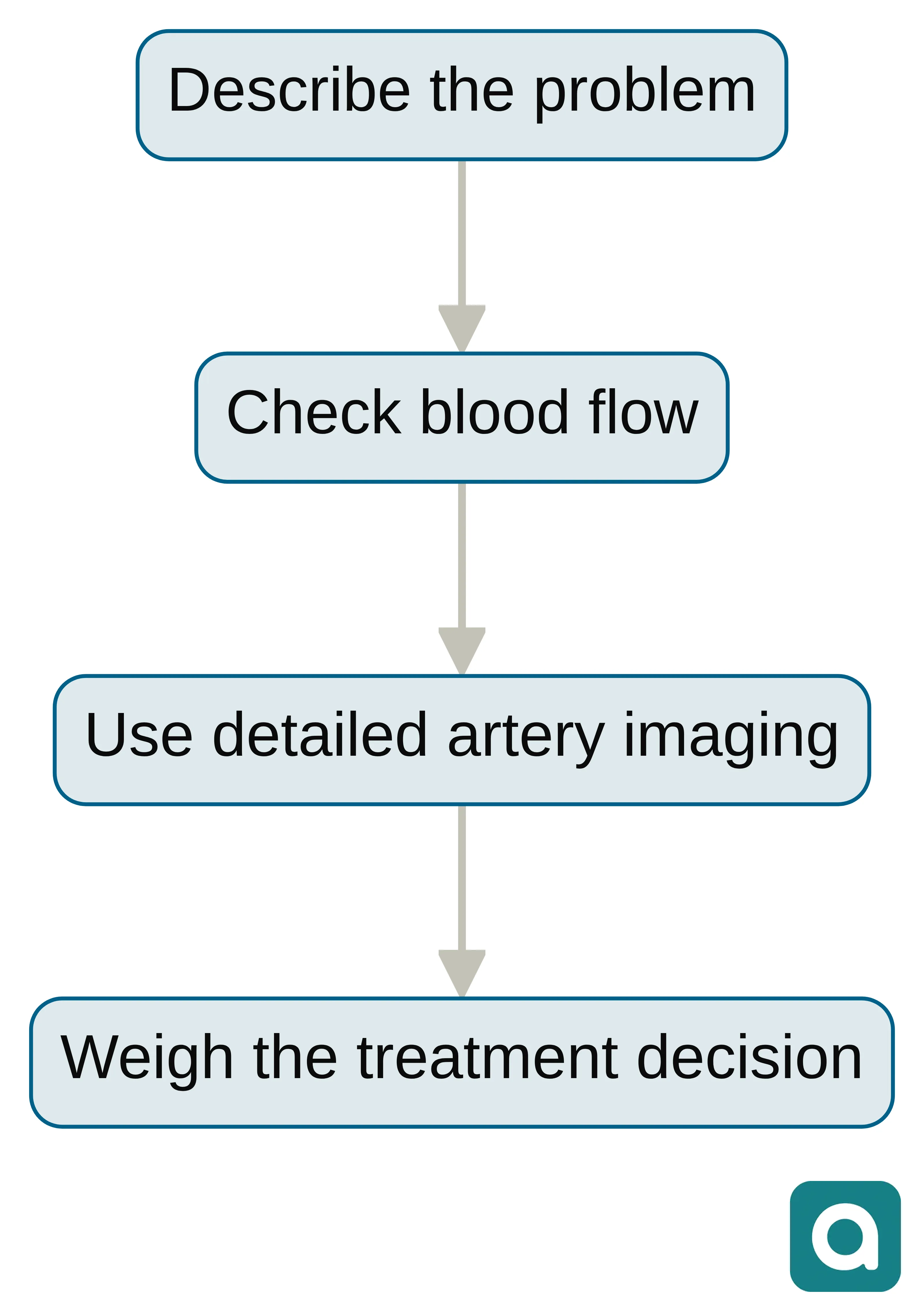
A useful relief discussion connects three points: how the symptoms affect walking and daily life, what structured care and medical management have addressed, and what the evaluation shows about blood flow. This keeps procedures in their proper role without treating a scan or a symptom label as a complete treatment plan.
At Amavita Heart and Vascular Health, we offer non-invasive in-office testing, including ankle-brachial index and Doppler ultrasound, during the same visit when needed. We serve patients across Miami-Dade County from locations in Kendall and North Miami Beach.
The practical takeaway is to view PAD pain relief as a staged clinical discussion: structured care and risk reduction provide the foundation, while testing and evaluation inform whether a minimally invasive option belongs in the conversation.
How do minimally invasive options fit into pain relief?
Minimally invasive peripheral artery options fit into pain relief only after symptoms and circulation findings support a treatment discussion.
Endovascular options can include angioplasty, stent placement, and atherectomy. The choice depends on the artery, the blockage, your symptoms, and the clinical evaluation.
- Angioplasty: This is an endovascular revascularization option that may enter the discussion when the clinical findings support treating a narrowed artery.
- Stent placement: A stent may be considered for selected iliac artery lesions, but stenting is not suitable for every artery or every person.
- Atherectomy: This may be included in an endovascular plan, but uncertainty remains about when adding it is justified.
These options are not interchangeable menu choices. The artery involved, the pattern of disease, your symptoms, other health conditions, previous treatment response, and your goals all affect the discussion. The expected durability of symptom relief also matters.
The comparison with structured care is about sequence and purpose. Structured care addresses symptoms, function, and quality of life through supervised exercise and medical management. Revascularization addresses persistent, function-limiting claudication when the evaluation supports considering a procedure. Neither description promises a particular result for you.
A procedure also does not replace the evaluation that comes before it. The clinician must connect the symptom pattern with circulation findings and decide whether the possible benefit of treating a blockage justifies discussing an endovascular option. The same procedure may not fit every artery or every person.
One reason this distinction matters is that not every PAD procedure discussion has the same goal. For claudication, guidance describes revascularization primarily as a way to improve symptoms, function, and quality of life—not automatically as limb-salvage treatment. Claudication doesn’t commonly progress to critical limb ischemia, so walking limitation and other symptoms need to be weighed separately from emergency signs. This doesn’t make persistent pain unimportant. It clarifies why the decision considers how much the symptom limits daily life, what medical therapy and structured exercise have addressed, and whether the expected benefit is worth an invasive step.
It also explains why a procedure can’t be chosen from the word “PAD” alone. The symptom category, artery findings, other health conditions, prior treatment response, and personal goals all shape the discussion. A symptom-focused procedure conversation shouldn’t imply that every person with claudication needs revascularization, or that revascularization addresses every broader PAD risk. Those risk questions remain part of medical management, even when the immediate reason for care is pain while walking.
This separation can help you ask a more precise question: Is this option being discussed to improve function, to address a circulation finding, or to address both? The answer depends on the clinical findings and goals, not on pain intensity by itself. Keeping these aims separate helps prevent treating a procedure as an automatic form of pain relief.
Our peripheral artery intervention service is part of this evaluation-based conversation. It is not a promise that angioplasty, stenting, or atherectomy will be recommended. A procedure is not selected from the symptom alone.
Knowing what each option does can make the conversation easier to follow. Angioplasty is an endovascular revascularization technique; a stent may be used as a primary treatment or after angioplasty for selected iliac artery lesions; atherectomy removes plaque and may be combined with angioplasty. Those descriptions explain the tools, not which one belongs in your plan. Ask which finding the proposed option would address, why that option is being discussed, and what uncertainty remains. This keeps the procedure conversation tied to the artery findings, symptom limits, earlier care, and your goals rather than to the procedure name alone.
What is a practical next step in Miami-Dade?
A non-emergency PAD concern can move toward an evaluation by gathering symptom details and choosing the Miami-Dade location that fits your needs. If sudden severe leg pain occurs with a cold, pale limb, go to the ER immediately instead of using a website form.
At Amavita Heart and Vascular Health, we serve patients across Miami-Dade County from locations in Kendall and North Miami Beach. We offer non-invasive in-office testing, including ankle-brachial index, Doppler ultrasound, or vein-reflux studies during the same visit when needed. We also provide multilingual care in English, Spanish, and Haitian Creole.
Use the Website callback request to request a call back; no appointment time is reserved. Gather:
- Whether the pain begins during walking and which activities it limits.
- Whether you have a wound that is not healing.
- Whether you have already had an ABI, Doppler ultrasound, or another circulation test.
- Which location is more practical for you: Kendall or North Miami Beach.
- Whether English, Spanish, or Haitian Creole would make the conversation easier.
These details can help organize a discussion about your symptoms and possible evaluation. They do not diagnose PAD or establish eligibility for angiography, angioplasty, stenting, or another treatment. A qualified professional must decide whether PAD is present and which care is suitable for your health and goals.
Have questions about your heart or circulation?
Reading only goes so far. Leave your number and a care coordinator will call you back within one business day, or call us now.