Peripheral Artery Intervention
Peripheral Artery Intervention: What to Know Before Requesting a Consultation

Is peripheral artery intervention worth discussing for your symptoms?
Leg pain during walking or a non-healing wound can make peripheral artery disease, or PAD, worth discussing with a cardiologist, but symptoms alone cannot determine whether you need a procedure. At Amavita Heart and Vascular Health, we identify leg pain when walking and non-healing wounds as symptoms that warrant seeing a cardiologist.
PAD can involve different levels of disease and different degrees of severity. Treatment can include medical management and risk-factor changes, and some forms of disease may also lead to discussion of an endovascular or surgical intervention. A consultation helps connect your symptoms with the circulation questions that need an answer.
A useful way to approach the subject is as a consultation-readiness question rather than a treatment choice. You can ask whether your symptoms call for a vascular evaluation, what testing may be appropriate, and which options belong in the conversation. We may recommend a peripheral vascular ultrasound when indicated as part of a heart evaluation.
That pathway is especially relevant if walking brings on leg pain, if a wound is not healing, or if you already know that PAD is part of your health history. It does not tell you that an intervention is needed. It gives you a clear reason to discuss circulation with an interventional cardiology or vascular team.
Bring the concern that led you to seek help, not a conclusion about the treatment you should receive. The purpose of the first conversation is to identify the circulation question, understand what evaluation may be needed, and decide whether a further discussion is appropriate.
What does peripheral artery intervention mean?
Endovascular PAD treatments can include balloon angioplasty, stenting, atherectomy, and drug-delivery systems. PAD care can also include medical treatment and, for some conditions, surgery.
Peripheral artery intervention describes a category of treatments, not one single procedure. The artery involved, the extent of disease, your symptoms, and the goals of care affect which options a clinician discusses. PAD is strongly connected with broader cardiovascular health, so the conversation may include more than the painful area in your leg.
Stenting is an endovascular treatment that may be discussed with angioplasty, while atherectomy and drug-delivery systems are additional approaches that may enter a treatment discussion. These terms describe tools; they do not by themselves establish which approach is appropriate for you.
Our clinician, Dr. Pedro Martinez-Clark, specializes in minimally invasive peripheral vascular interventions. You can use a consultation to ask which term applies to your situation, what the proposed procedure is intended to address, and what other forms of care should be considered.
It describes how access to the artery may be obtained. The evaluation still has to connect the proposed technique with the artery, symptoms, and goals under discussion.
Why might a clinician evaluate someone for intervention?
A clinician may evaluate you for an intervention when PAD symptoms or tissue concerns suggest that improving blood flow needs to be considered. Revascularization may sometimes be recommended for some people with PAD to improve blood flow and help prevent tissue damage. Leg pain while walking and non-healing wounds are symptoms we identify as reasons to see a cardiologist at Amavita Heart and Vascular Health.
Evaluation does not equal eligibility. PAD can have variable presentations and severity, and traditional claudication—leg discomfort linked with walking—or chronic limb ischemia can involve different treatment discussions. Your symptoms provide a reason to seek an assessment, not a conclusion about the procedure you should receive.
Medical treatment and risk-factor management remain part of the broader PAD conversation. Endovascular interventions may relieve PAD-related symptoms and reduce morbidity, while long-term medical treatment remains essential to prognosis. A consultation should therefore address the full plan rather than treating an artery procedure as a replacement for ongoing care.
You can ask four focused questions:
- What circulation problem are we trying to understand?
- Could medical management be part of the plan?
- If an intervention is discussed, what is it intended to address?
- What other options should we compare before making a decision?
Those questions keep the conversation tied to your symptoms and health goals without asking you to choose a treatment before an evaluation.
The reason for an evaluation may also change as more information becomes available. A symptom, a circulation finding, and a wound concern do not answer the same clinical question. Ask which finding is driving the discussion and what decision the next test or consultation is meant to support.
What happens before anyone discusses a procedure?
The treatment discussion can include medical management, risk-factor changes, an endovascular approach, or surgery when those options fit the condition being evaluated. A clinician may also explain why a procedure is not the first topic for your situation. That explanation is useful because intervention is only one part of PAD care.
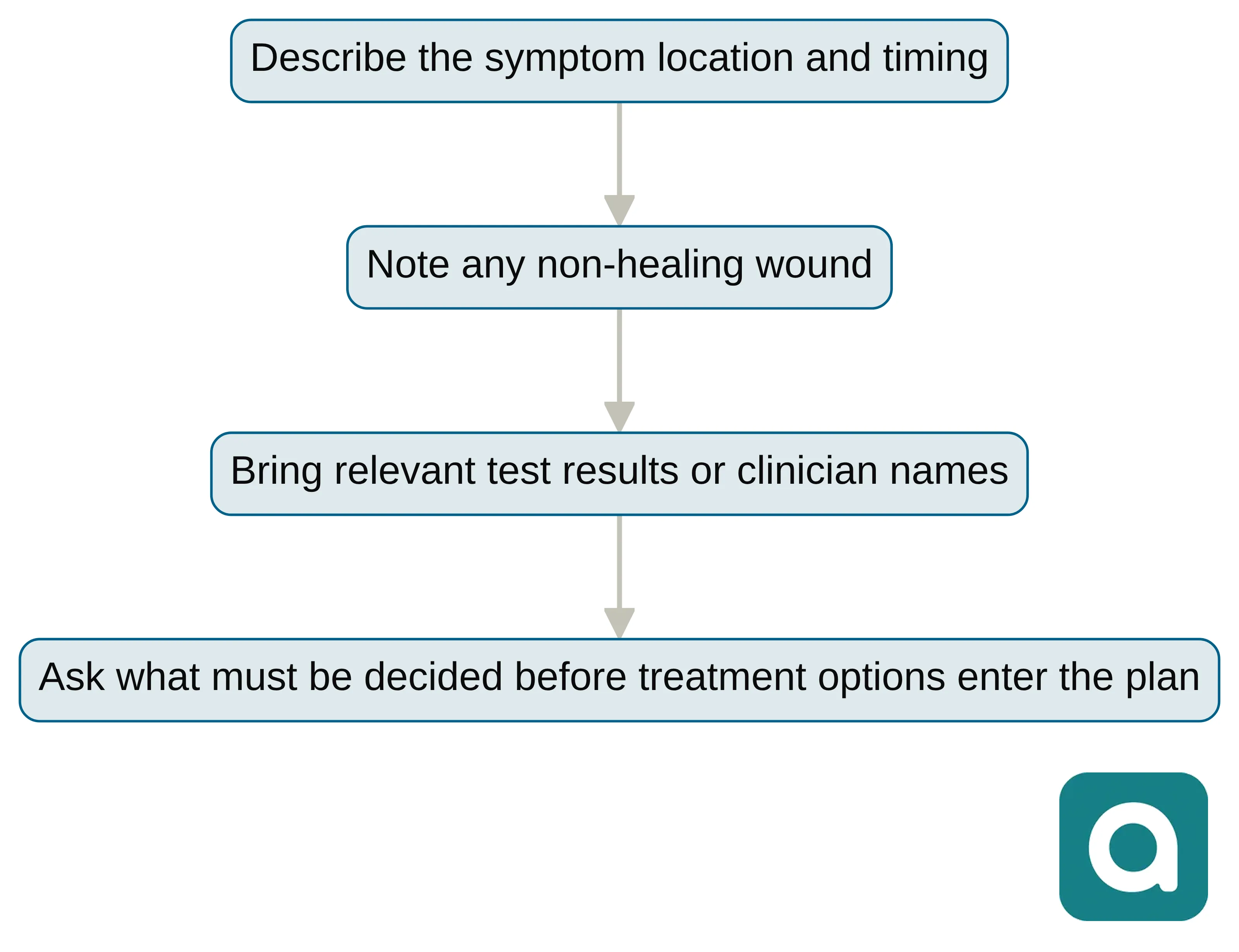
You do not need to arrive with a preferred device or procedure name. Instead, organize the information that helps the team understand your concern:
- Describe the symptom, its location, and when it occurs.
- Note any wound that has not healed and how long it has been present.
- Bring relevant test results or the names of clinicians who have evaluated you.
- Ask what needs to be decided before angioplasty, stenting, another intervention, or surgery enters the plan.
This preparation supports a focused conversation. It does not allow you to determine your own eligibility from a checklist.
PAD can vary enough that collaboration among medical and surgical specialists may help tailor care to your needs. We provide minimally invasive peripheral vascular interventions, so you can ask how an interventional cardiology evaluation fits with the rest of your cardiovascular care.
You can also ask what information is still needed before the team can discuss a specific approach. That might include a clearer description of your symptoms, a circulation assessment, or imaging related to the artery under consideration. The answer should be tied to your clinical question rather than to a procedure name you found first. If a peripheral vascular ultrasound is recommended, ask what circulation question it is meant to answer and what decision its findings will support. Amavita Heart and Vascular Health says this test may be recommended when indicated as part of a heart evaluation. The test is one piece of information for the discussion; it does not, by itself, establish that an intervention is needed.
If more than one kind of specialist is involved, ask who will explain the options and how the recommendations fit together. The scientific statement describes collaboration among surgeons, interventionalists, social workers, occupational therapists, and physical therapists as a possible part of multidisciplinary PAD care. You can ask which members are relevant to your situation rather than assuming every visit includes every role.
How do angioplasty and stenting work in general?
We provide minimally invasive peripheral vascular interventions, and Dr. Pedro Martinez-Clark specializes in this area. If a procedure is discussed, ask what the catheter-based plan involves, whether angioplasty alone or stenting is being considered, and what alternatives remain available.
You can also ask what preparation, monitoring, and follow-up the proposed plan requires. The general procedure terms do not answer those practical questions. Your care team must explain the details of the particular artery and procedure under discussion.
A useful explanation should cover the intended target, the technique being proposed, and the reason that technique fits the findings. It may be done during angioplasty, but that possibility does not establish that a stent fits your artery, symptoms, or goals. Ask the team to connect the proposed tool to the finding it is meant to address. Ask whether a stent is part of the plan or only a possibility. Ask what follow-up will be used to assess the treated area. Those details are more useful than treating angioplasty or stenting as a single fixed experience for everyone.
What does the evidence not settle?
For traditional claudication and chronic limb ischemia, no clear evidence establishes surgical therapy as superior to endovascular therapy or endovascular therapy as superior to surgery. Comparative trials have limitations, so the treatment conversation should not be reduced to a universal ranking.
That uncertainty does not mean that every option is equal for every situation. It means the relevant comparison depends on the condition being treated, the goals of care, and the clinical details of the artery involved. Ask what question the proposed treatment is meant to answer and why that approach is being considered.
Endovascular interventions may relieve PAD-related symptoms and reduce morbidity, but long-term medical treatment remains essential to prognosis. PAD is also strongly associated with broader cardiovascular illness and mortality, which is why a leg circulation discussion belongs within your overall heart health plan.
We provide care in English, Spanish, and Haitian Creole. You can ask questions in your preferred language while discussing how the procedure question fits with your wider cardiovascular care.
The evidence therefore supports a careful discussion, not a promise that one route will fit every case. Ask how the clinical team is weighing the artery involved, the reason for treatment, the alternatives, and the continuing medical care that remains part of the plan.
What should you know about risks and limits?
Angioplasty has risks, including artery injury, clotting, bleeding, infection, a reaction to contrast material, recurrent blockage, and rare serious complications. Catheter access can injure an artery, and heavy bleeding at the insertion site may require additional treatment. A procedure that uses contrast material can also cause an allergic reaction.
A blockage can recur after angioplasty, whether or not a stent is placed during the procedure. Recurrence is a limit to discuss before you agree to a plan. Ask how the care team will monitor the treated area and what symptoms after the procedure should prompt a call or urgent evaluation.
Risk information should stay close to the procedure being considered. The general risk list does not tell you which risks apply to your health history, the artery being treated, or the planned technique. Ask about contrast use, access-site bleeding, recurrent narrowing, infection, and the rare complications that matter for your procedure.
We provide minimally invasive peripheral vascular interventions. That service description does not promise a particular result or remove the need to discuss limits, alternatives, and follow-up with the clinical team.
You can ask for the risks in practical terms: which problems are common enough to plan for, which warning signs need urgent attention, and how follow-up will address recurrence or a complication. The answers should relate to the proposed technique and your health history, not only to a general description of angioplasty.
When is leg pain an emergency instead of a callback?
Sudden severe leg pain with a cold, pale limb is an emergency, not a routine callback request. We advise going to the emergency room immediately if those warning signs occur.
We serve patients across Miami-Dade County from locations in Kendall and North Miami Beach, but an emergency symptom requires immediate emergency-department care rather than waiting to contact either location. Do not use a routine consultation pathway for this situation.
A routine consultation is intended for questions about symptoms such as leg pain while walking or a non-healing wound when the emergency warning signs above are not present. If the leg becomes suddenly severely painful, cold, and pale, choose immediate emergency care first.
The distinction is about timing. Walking-related symptoms and a non-healing wound can be brought to a consultation when the emergency warning signs are absent. Sudden severe pain together with a cold, pale limb should not wait for a callback, office response, or routine testing.
What does outpatient care mean at Amavita Heart and Vascular Health?
We provide same-day outpatient care in our service context, but that does not mean every evaluation or procedure will happen the same day.
Ask whether your next step is an office evaluation, a test, or a planned procedure. Ask what needs to happen before the procedure can be scheduled and whether you should arrange transportation or time away from normal activities. These questions clarify the practical meaning of outpatient care without treating same-day service as a promise.
We serve patients across Miami-Dade County from locations in Kendall and North Miami Beach. We also provide care in English, Spanish, and Haitian Creole. When you contact us, include your preferred office and preferred language so the team has the right information for the next conversation.
Outpatient describes the care setting, not the answer to whether an intervention is appropriate. Your symptoms, evaluation, and the proposed plan still need to be discussed before any procedure decision is made.
Ask about the expected sequence before you plan around a same-day visit. The next appointment may be for evaluation rather than treatment, and the timing of any later procedure depends on what the clinical discussion establishes.
What should you include when requesting a callback?
When you are ready to discuss peripheral artery care, prepare the details that will help our team understand your question. Include:
- your name, phone number, and email;
- your insurance plan;
- your preferred office;
- the reason for your visit;
- your preferred language; and
- notes about your symptoms or previous testing.
You can mention whether leg pain occurs while walking, whether you have a non-healing wound, and whether you have questions about angioplasty, stenting, evaluation, or outpatient care.
We serve Miami-Dade County from Kendall and North Miami Beach and provide care in English, Spanish, and Haitian Creole. Include the office and language that fit your needs so the callback conversation can begin with the right practical details.
A qualified clinician must decide whether a procedure fits your condition after the appropriate evaluation. Share the symptoms and questions that prompted you to seek help, while remembering that sudden severe leg pain with a cold, pale limb requires immediate emergency-room care instead of a routine contact.
Have the requested details ready so our team can understand what you want to discuss.
What should patients ask before discussing peripheral artery intervention?
What symptoms might indicate the need for a vascular evaluation?
Symptoms such as leg pain while walking and non-healing wounds may suggest the need for a vascular evaluation. These symptoms warrant a discussion with a cardiologist to assess circulation and determine appropriate care.
What are the risks associated with angioplasty?
Angioplasty carries risks such as artery injury, blood clots, bleeding at the catheter site, and recurrent blockages. It’s important to discuss these risks with your care team before proceeding.
What makes leg pain an emergency?
Sudden severe leg pain with a cold, pale limb requires immediate emergency care. Go to the emergency room rather than requesting a routine callback.
What information should I provide when requesting a callback?
When requesting a callback, include your name, phone number, email, insurance plan, preferred office, reason for your visit, preferred language, and details about your symptoms or previous testing.
Have questions about your heart or circulation?
Reading only goes so far. Leave your number and a care coordinator will call you back within one business day, or call us now.