atrial fibrillation treatment
AFib treatment decisions: What to know before discussing catheter ablation

How can you read AFib treatment evidence?
AFib treatment decisions are not simply a choice between taking a medicine and having an ablation. A study may address rate control or rhythm control without answering every question about the other approach. AFib is the most common sustained heart-rhythm disorder, and it can affect symptoms, daily function, and quality of life. A focused conversation can help you understand what needs attention first and whether rhythm control belongs in the discussion.
AFib care may focus on rate control or rhythm control. Rate control aims to manage how fast the heart’s lower chambers beat, while rhythm control aims to maintain a normal rhythm. Those are different goals, and they do not automatically lead to the same treatment plan. Your cardiology conversation should also cover the steps that come before a rhythm procedure, including the evaluation of related conditions and the plan for reducing stroke and clot-related risk.
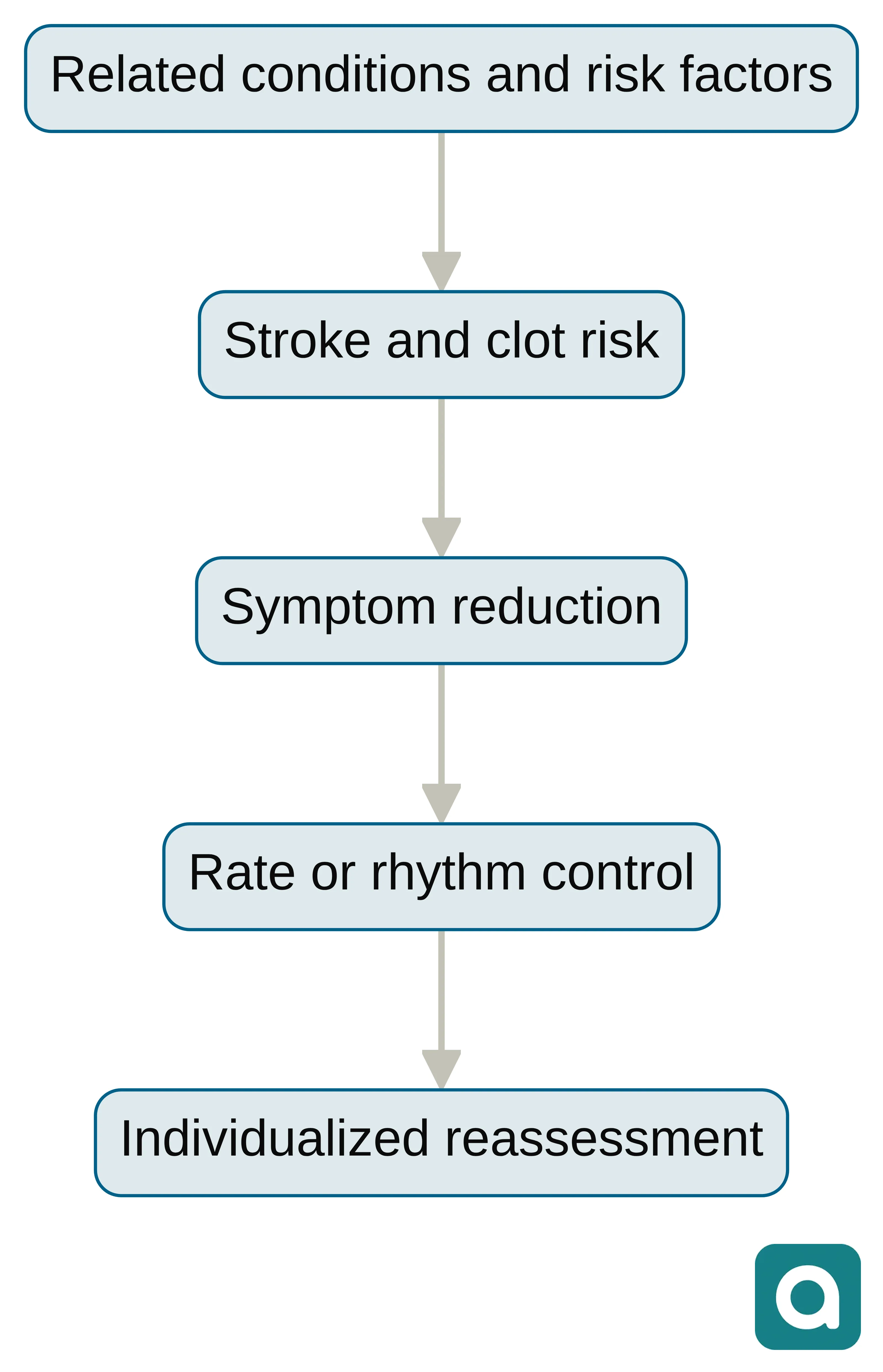
The 2024 European Society of Cardiology framework starts with related conditions and risk factors, then considers stroke prevention, symptom reduction, and rate or rhythm control. It also calls for evaluation and follow-up to be individualized and revisited as AFib and associated health issues change. That framework gives you a useful way to organize questions without turning a general article into a personal treatment recommendation.
A useful starting question is: “What are we trying to improve first?” Your answer might involve bothersome episodes, a persistently fast heart rate, limits on daily activity, medication side effects, or concern about how the rhythm is changing over time. You do not need to choose a procedure before that question is answered. You need enough information to compare the next reasonable options with your care team.
If your care is in Miami-Dade County, you can also ask how the evaluation, testing, follow-up, and communication will be coordinated between visits. A treatment choice is easier to understand when you know what decision it is meant to address.
What should be addressed before rhythm control?
AFib management begins with related health conditions and risk factors before a clinician weighs rate or rhythm control. The 2024 European Society of Cardiology framework places this step first for people with AFib, followed by consideration of stroke and thromboembolism prevention, symptom reduction, and options for controlling the rate or rhythm. This order does not mean every person follows the same sequence in practice. It means the wider picture matters before an isolated procedure decision.
Before you discuss ablation, ask your clinician to separate these four questions:
- What conditions or risk factors need attention alongside AFib?
- What is the plan for stroke and clot-related risk?
- Are your symptoms mainly related to the rhythm, the heart rate, another condition, or more than one cause?
- Is the current goal rate control, rhythm control, or a staged approach?
These questions keep the conversation practical. They also make it easier to understand why a clinician may recommend evaluation or treatment beyond the rhythm itself.
AFib follow-up is meant to change when your condition or related health issues change. A plan that made sense after an initial diagnosis may need to be revisited after new symptoms, a medication problem, a change in episode pattern, or new test results. Ask how the team will reassess your plan and which changes should prompt you to contact them.
AFib evaluation may include your medical history, a physical examination, and an electrocardiogram, also called an EKG. Some people also need an electrophysiology study, which examines the heart’s electrical activity in more detail. Bringing prior test results and a clear symptom timeline can help the appointment start with the information your clinician needs.
A practical way to prepare is to separate what you know from what you are unsure about. Write down the rhythm diagnosis you were given, the symptoms you noticed, and the questions that remain. Your clinician can then explain which findings are confirmed and which need more testing.
What information helps a clinician discuss ablation?
AFib episode details help a clinician understand the rhythm pattern before discussing ablation. Your team may want to know when episodes began, how long they lasted without treatment, whether they stopped on their own, and how symptoms changed during them. Clinicians classify AFib partly by how long it continues: persistent AFib lasts beyond seven days when untreated, while permanent AFib reflects acceptance of continuing AFib or an inability to restore rhythm with cardioversion. Classification is a clinical description, not a decision that you can make from symptoms alone.
Bring information that makes the timeline easier to follow:
- Dates or approximate timing of noticeable episodes.
- Palpitations, fatigue, shortness of breath, reduced activity, or other symptoms and what you were doing when they occurred.
- Names and doses of current or recently stopped medicines, if available.
- Side effects, missed doses, or episodes that continued despite medication.
- EKGs, monitors, imaging reports, laboratory results, and discharge paperwork you already have.
This list is preparation, not a test. If you do not know an exact date or dose, say so rather than guessing.
Medication history matters because medicines help many people control rapid or irregular heartbeats, but they may not work for everyone and can cause side effects. Tell your clinician what you have tried and what happened. Do not stop, restart, or change a heart medicine based on a general article; ask the prescribing clinician for instructions.
A clinician may combine your history with an examination, an EKG, and other testing when needed. The pattern of your AFib, the results of those tests, and the health conditions being managed alongside it all shape the conversation. Ask which finding matters most in your case and which information would change the options under consideration.
You can also ask whether the available records show the rhythm clearly enough to guide a discussion. If the answer is no, ask what monitoring or other evaluation would help. That keeps you from treating an uncertain label as a final treatment decision.
When might medication and ablation enter the same conversation?
Medication and catheter ablation may enter the same AFib conversation when medication does not work well enough or causes side effects. Catheter ablation is used to help control AFib, but that general fact does not establish that ablation is appropriate for you. A clinician still needs to consider your rhythm pattern, symptoms, other health conditions, previous treatment, and goals.
The comparison also depends on the goal. Rate control focuses on keeping the heart rate within a target range. Rhythm control focuses on maintaining a normal rhythm. The 2024 European Society of Cardiology framework places both choices after attention to related conditions, risk factors, and stroke prevention. Ask your team to explain which goal is being considered and how success would be judged in your care plan.
A balanced comparison should cover more than whether a treatment can reduce episodes. Ask about:
- Expected effect on the symptoms that trouble you most.
- Medication use before, during, or after a procedure.
- The practical burden of each option, including visits and follow-up.
- Medication side effects, the invasive nature of ablation, and the possibility of early rhythm recurrence after ablation are trade-offs to discuss with your cardiology team.
- What would happen if the first plan did not control the rhythm.
- How recurrence would be recognized and managed.
Your care team can connect these questions to your records. General information can help you prepare, but it cannot select an option for you.
A complete comparison also needs a plain-language risk discussion. Ask the team to separate four categories: medication-related side effects; risks or possible complications associated with an invasive procedure; the chance of early rhythm recurrence and the uncertainty around longer-term results; and the practical burdens of preparation, monitoring, follow-up, transportation, time away from work, and support at home. This does not mean each category applies in the same way to every person. It gives you a checklist for asking what is relevant to your history and what remains unknown. Ask which concerns are connected to the medicine, which are connected to the procedure, and which concern whether the rhythm benefit will last. Ask what information would change the balance between the options and what follow-up or contact plan applies if a concern appears. The treating cardiology team should explain individualized risk details rather than relying on a general article or a broad label such as minimally invasive. A fair comparison includes what may help, what may be difficult, and what the team cannot predict yet.
A systematic review notes that some people and clinicians view an invasive procedure as carrying more perceived risk than medication, while cost and social factors can also affect access to ablation. Those practical concerns belong in the discussion rather than being treated as afterthoughts. Ask what preparation, follow-up, transportation, time away from work, and support at home would mean for each option in your situation.
The comparison does not have to be settled in one visit. You can ask for the reason behind each proposed step, what information it is meant to provide, and when the plan will be reassessed.
What does the evidence suggest—and what does it not prove?
A systematic review reports that several randomized trials found catheter ablation more effective than antiarrhythmic drugs at maintaining a normal rhythm. The same review reports reductions in AFib burden and progression, improved quality of life, and lower health-care resource use with ablation compared with antiarrhythmic drugs. These are findings across studied groups and outcomes; they are not a personal success estimate.
The long-term comparison between ablation and drug therapy remains uncertain because the cited randomized trials were modest in size. That limitation matters when you move from a study result to a personal decision. A treatment can show an advantage for rhythm or symptoms in a study while still leaving questions about how durable that advantage will be for a particular person.
The evidence therefore supports a measured conclusion: ablation is a serious rhythm-control option that may offer advantages over antiarrhythmic medication for some studied outcomes, but the long-term balance is not settled for every situation. The evidence does not provide a universal success rate, remove the need for an evaluation, or show that a procedure is automatically preferable to medication.
When you hear a claim about “success,” ask what the word measures. It could mean fewer documented episodes, more time in a normal rhythm, fewer symptoms, less medication, improved quality of life, or another outcome. Ask how long the result was measured, which people were included, and whether the result applies to the rhythm pattern and health conditions being discussed in your appointment.
Also ask what tradeoffs were measured. A study may focus on rhythm, while your main concern is fatigue, activity, medication burden, or the need for follow-up. Matching the study outcome to your own goal makes the conversation more useful.
Why can treatment evidence point in more than one direction?
AFib treatment evidence can point in more than one direction because studies may compare different therapies, enroll different groups, and measure different outcomes. Clinical evidence leaves the long-term benefits of ablation compared with drug therapy uncertain, while a review reports better rhythm-related outcomes with ablation in several randomized trials. Those statements can both be accurate when their time frames and endpoints differ.
The EAST-AFNET trial studied 2,789 people across 135 centers who had AFib diagnosed within one year and other cardiovascular conditions. Early rhythm control, which included antiarrhythmic medication or catheter ablation, was associated with a lower rate of death, stroke, or serious treatment-related adverse events than usual care. This result concerns an early rhythm-control strategy, not ablation alone, so it should not be presented as a catheter-ablation success rate.
A rate-control comparison, a rhythm-control comparison, and an ablation-versus-medication comparison answer different questions. The same is true of symptom results, rhythm results, quality-of-life results, and serious health outcomes. Ask which question a study answered before using it to guide your own discussion.
You can make conflicting information easier to sort by asking three short questions:
- What treatment was compared with what?
- What outcome was measured?
- How long were people followed?
A clinician can then explain whether the result is relevant to your episode pattern, treatment history, and care goals. You do not need to resolve every research disagreement before requesting an evaluation. You do need to avoid turning one result into a promise about your own outcome.
What can procedural evidence tell you about AFib ablation?
A clinical trial compared pulmonary-vein isolation by catheter ablation with rate- or rhythm-control drug therapy. The passage describes mapping-guided ablation, antral isolation, and wide-area circumferential ablation as approaches used in that trial. This tells you that procedural studies can compare a defined ablation approach with medication-based care; it does not tell you which approach, if any, your clinician will use.
Pulmonary-vein isolation is the procedure label used in the trial, and mapping-guided treatment is one of the approaches it describes. Ask your team to explain the planned procedure in plain language, including what will happen before it, how the rhythm will be monitored, and what follow-up will involve. Amavita Heart and Vascular Health offers minimally invasive heart and vascular procedures and same-day outpatient care; whether those terms apply to your AFib ablation, along with your medication instructions, discharge plan, and recovery schedule, must be confirmed with the treating team. Ask the team to describe the visit in three stages: what preparation comes first, what happens during the catheter procedure, and what monitoring and instructions follow immediately afterward.
Use the procedural conversation to clarify details rather than assume that every ablation follows the same path. Ask:
- What type of ablation is being considered for my rhythm pattern?
- What testing is needed before the procedure?
- What medicines should I take or avoid before and after it?
- What monitoring and follow-up are planned?
- Who should answer questions after I leave the procedure setting?
Written answers can make the plan easier to follow when you are comparing options or discussing it with family.
A procedure label does not predict your result. Your clinician must connect the technical plan to your health history, AFib pattern, treatment goals, and the risks that apply to you. Keep those questions together so the discussion stays focused on your care rather than on a procedure name alone.
You can also ask what would make the team change the plan. The answer may involve a test result, a medication issue, a change in symptoms, or another health condition. Knowing that boundary helps you understand which parts of the plan are fixed and which parts depend on evaluation.
What should you ask about recovery and recurrence?
AFib or atrial tachycardia can recur during the first two to three months after ablation, and some early recurrences may resolve on their own. The first three months are often called a blanking period. Early rhythm problems may be linked with later recurrence, but that relationship is still being studied. An early episode therefore deserves a clear plan from your clinical team rather than an immediate assumption that the procedure has failed.
If a repeat ablation is being considered, clinicians may defer it for at least three months after the first procedure when possible because early recurrences may resolve. This general timing point is not an instruction for your care. Your clinician may need to consider your symptoms, rhythm findings, medicines, and overall condition before deciding what to do.
Before a procedure, ask the recovery questions that will matter at home:
- Which symptoms should you record, and how should you record them?
- How will the team distinguish an expected early rhythm change from a problem that needs attention?
- When is the first follow-up, and what testing will be used?
- How long should you plan for help with transportation or daily tasks?
- What is the plan if symptoms return during the first three months?
- Who should you contact with a question about medicines or rhythm symptoms?
The answers should be written in terms you can follow, not only in technical language.
Recurrence deserves careful wording. Early recurrence may be part of the blanking-period discussion, while later recurrence can lead to a different assessment. The relationship between early and later recurrence remains under investigation, so an early episode should prompt communication with your care team and a review of the plan rather than a conclusion based on timing alone.
Ask how recurrence will be documented and what information the team wants before the follow-up visit. A short record of timing, symptoms, and any instructions you received can make that discussion more specific.
Which recovery details still require a direct clinical answer?
Recovery details require a direct answer from the team planning your care. Ask about the expected length of monitoring, when you may drive, when you may return to work or exercise, how medicines will be handled, and when follow-up testing will occur. Those details depend on the procedure plan and your health history, so a general article should not give you a fixed schedule.
Your recovery plan should also explain what to do if symptoms return. Ask whether you should record the time, duration, heart rate, triggers, and associated symptoms, and ask which team member receives that information. A written plan can reduce confusion when an early rhythm change occurs during the first three months.
If your planned care is described as outpatient or same-day, ask what observation, transportation, and at-home support are still required. That label alone does not answer how long you will be monitored or what restrictions will apply.
After a consultation, we provide a written plan covering lifestyle recommendations, medications, testing, and referrals as needed. If you speak with Amavita Heart and Vascular Health about AFib care, ask how your plan will address the recovery details that apply to you and when it will be reviewed.
Do not fill in missing instructions from someone else’s recovery story. Use your own written plan and contact the clinical team when your symptoms or questions do not fit it. Before leaving a visit, repeat the main instructions in your own words and ask whether you understood them correctly. That simple step can identify an unclear medication, follow-up, or activity instruction.
When should you request a cardiology consultation?
You should request a cardiology consultation if an irregular rhythm has been detected or if you have unexplained palpitations, fatigue, or shortness of breath. Amavita Heart and Vascular Health recommends cardiology evaluation in those situations. These symptoms can have different causes, so the purpose of the consultation is to evaluate them rather than to assume that AFib or ablation is the answer.
A cardiology consultation may include a review of your medical history, a physical examination, and an EKG. Some patients also need an electrophysiology study. Bring your symptom timeline, medication list, and prior test reports so the team can connect your experience with the available clinical information.
A consultation is especially useful when you need to clarify one of these points:
- Whether the rhythm has been documented and how it is classified.
- Whether your current goal is rate control, rhythm control, or both at different stages.
- Whether medication has helped enough or caused problems that need discussion.
- Whether catheter ablation belongs among the options being considered.
- Which tests, specialists, or follow-up steps are needed next.
You are asking for an evaluation, not requesting that a specific procedure be selected in advance.
Amavita Heart and Vascular Health serves patients across Miami-Dade County from locations in Kendall and North Miami Beach. If North Miami Beach is the practical location for you, include that preference when you contact the practice and ask how the consultation process applies to your questions.
A callback request starts a conversation with the care team. It does not determine candidacy or reserve an appointment time.
What should you bring to the conversation?
Your AFib consultation will be more focused if you bring the information that shows how the rhythm has affected you over time. A clinician may review your history, examination findings, EKG results, and other tests, while follow-up should be individualized as AFib and related health issues change.
Prepare a short record with:
- When symptoms started and how long episodes seemed to last.
- What you felt during an episode, including palpitations, fatigue, shortness of breath, or reduced activity.
- How often symptoms occur and whether anything seems to bring them on.
- Current medicines, previous medicines, and side effects or concerns.
- EKGs, rhythm-monitor reports, imaging, laboratory results, and hospital paperwork.
- Your main goal, such as fewer symptoms, better daily activity, or a clearer plan for follow-up.
Use approximate information when exact details are unavailable. The purpose is to give your team a usable timeline.
Write down questions before the appointment so the discussion does not depend on memory. Useful questions include: “What is my AFib pattern?” “What is the main goal of treatment?” “What should be addressed before rhythm control?” “Why are you discussing medication, ablation, or both?” and “What would follow-up look like if symptoms return?”
You can also ask who will explain the procedure, who will manage medicines, and how questions will be handled after the visit. If family or a support person helps you make decisions, ask whether that person may join the conversation. Clear roles make the next step easier to understand.
Bring practical questions too. Ask what records should be sent ahead, whether language support can be arranged, and how you will receive the written plan. These details help you take part in the decision without changing the clinical evaluation itself.
Before you leave, turn the discussion into a short decision record. Note the treatment goal, the information that has been confirmed, the information that is still needed, and the next review point. Add why medication, ablation, or continued evaluation is being discussed, along with what could cause the plan to change. You can also write down who will answer questions, how you will receive the written plan, and which language you prefer for follow-up. This record does not tell you which treatment to choose. It helps keep a study result, a general procedure description, or an early symptom change from becoming a personal assumption. It also gives you a focused list to review when you speak with a North Miami Beach cardiology team or submit a callback request to Amavita Heart and Vascular Health.
What access questions matter in North Miami Beach?
Amavita Heart and Vascular Health provides care in English, Spanish, and Haitian Creole. If you prefer one of those languages, state that preference when you contact the practice. You should be able to ask for explanations of the rhythm, treatment choices, medicines, procedure, and follow-up in language you understand.
Ask access questions that affect the whole plan:
- Where will the consultation take place?
- Which language should be requested for the visit?
- Which records should be sent or brought?
- Who should receive questions after the consultation?
- How will follow-up be arranged if your symptoms or treatment plan change?
These questions do not determine whether ablation is appropriate. They help you understand how to take part in the evaluation.
North Miami Beach patients can use the consultation to discuss both clinical and practical concerns. Tell the team about language needs, transportation limits, work responsibilities, and support at home so those concerns can be included in the planning conversation.
You can ask for plain explanations in English, Spanish, or Haitian Creole and request that key instructions be written down. Understanding the plan is part of being able to follow it, especially when it includes testing, medication questions, and follow-up.
What can Amavita Heart and Vascular Health provide after a consultation?
Amavita Heart and Vascular Health provides long-term medical management and procedural treatment for atrial fibrillation, heart failure, and other rhythm disorders. That means your conversation can address ongoing care as well as a possible procedure, rather than treating ablation as a stand-alone decision.
After your consultation, we provide a written plan covering lifestyle recommendations, medications, testing, and referrals as needed. The plan can give you a place to record the treatment goal, questions about rhythm control, follow-up timing, and the circumstances that should prompt you to contact the team.
Our Dr. Pedro Martinez-Clark specializes in minimally invasive cardiac catheterization, coronary revascularization, peripheral vascular interventions, and structural heart disease. Those services describe areas of specialization; they do not establish that catheter ablation is appropriate for every person with AFib. Your consultation remains the place to discuss the rhythm-specific options that fit your evaluation.
We serve patients across Miami-Dade County from locations in Kendall and North Miami Beach, and we provide care in English, Spanish, and Haitian Creole. You can bring your language preference and location needs into the same conversation as your questions about testing, medication, ablation, and follow-up.
The useful outcome of a consultation is a clearer plan for your questions and next steps. It may include further testing, continued medical management, a discussion of procedural care, or a referral when another service is needed. Ask the team to explain why each step is included and what decision it is meant to inform.
If you are comparing medication and ablation, ask for the comparison in terms that matter to you: symptom control, rhythm monitoring, medication effects, follow-up, practical demands, and uncertainty about longer-term results. That keeps the conversation centered on your goals rather than on a procedure name.
How can you compare AFib treatment study results?
AFib treatment studies can answer different questions, so a result about maintaining sinus rhythm is not the same as a result about AF burden, quality of life, or death, stroke, and serious treatment-related adverse events. To understand what a finding may mean for your next conversation, identify the treatment tested, the outcome measured, and the limits described by the study.
Remember that early rhythm changes can occur during the first two to three months after ablation, and the first three months are often treated as a blanking period. Ask how recurrence, medicines, testing, and follow-up will be handled before you make a decision. A qualified clinician must determine whether any treatment is suitable for you.
If an irregular rhythm has been detected or you have unexplained palpitations, fatigue, or shortness of breath, prepare those details for a cardiology conversation. Amavita Heart and Vascular Health serves patients in North Miami Beach and across Miami-Dade County, with care available in English, Spanish, and Haitian Creole. Bring your questions and ask for a plan you can understand.
A qualified professional must decide whether a treatment is suitable for you after reviewing your health history, rhythm findings, goals, and practical needs.
What should patients ask before discussing AFib ablation?
What are the main treatment options for atrial fibrillation?
Atrial fibrillation treatment options include rate control, which manages how fast the heart beats, and rhythm control, which aims to maintain a normal heart rhythm. Medications are often used, but catheter ablation may be suggested if medications are ineffective or cause side effects.
What should I discuss with my clinician before considering catheter ablation?
Before discussing catheter ablation, it’s important to address related health conditions, stroke prevention plans, and the specific symptoms you are experiencing. Understanding these factors can help clarify whether rhythm control is appropriate for you.
How can I prepare for a consultation about atrial fibrillation?
To prepare for your consultation, bring a record of your symptoms, medication history, and any previous test results. Write down questions you have about your AFib pattern, treatment options, and what to expect from the consultation.
When should I seek a cardiology consultation for atrial fibrillation?
You should request a cardiology consultation if you experience an irregular heart rhythm, unexplained palpitations, fatigue, or shortness of breath.
What can I expect after a catheter ablation procedure?
After catheter ablation, you may experience early recurrences of AFib or atrial tachycardia, especially in the first two to three months, which is often referred to as a blanking period. It’s important to have a clear follow-up plan with your clinician to monitor your recovery.
What should I ask about the risks and benefits of catheter ablation?
When discussing catheter ablation, ask about the expected benefits, potential risks, and how the procedure compares to medication in terms of managing your symptoms and improving your quality of life.
Have questions about your heart or circulation?
Reading only goes so far. Leave your number and a care coordinator will call you back within one business day, or call us now.