new treatments for PAD
New treatments for PAD: How angioplasty, stenting, and atherectomy compare

What counts as a new PAD treatment?
New treatments for PAD are not one single procedure that fits everyone. The broader PAD treatment landscape also includes medicines and non-procedural care; this article limits its comparison to endovascular procedures.
Peripheral artery disease, or PAD, is plaque buildup in the arteries that supply your legs. The buildup can reduce blood flow. Treatment discussions may focus on leg pain during walking, difficulty walking, non-healing wounds, or circulation problems that put a limb at risk.
The phrase “new treatment” can describe a newer procedure, a newer use of an existing procedure, or a treatment that is still being studied. Angioplasty, stent placement, and atherectomy are different endovascular options. Endovascular means that a clinician works through the blood vessels, usually with catheter-based imaging and treatment, rather than beginning with open surgery. The evidence here supports comparing these options, not declaring one universally suitable.
At Amavita Heart and Vascular Health, we offer minimally invasive peripheral vascular interventions. A consultation can help connect your symptoms and test results with the treatment question you need answered.
Endovascular revascularization guidance covers procedures involving arteries such as the iliac, femoral, and popliteal arteries, including angioplasty and stent placement. The artery’s location matters because a treatment discussed for a selected iliac lesion may not be the same treatment considered for a blockage lower in the leg.
That distinction gives you a practical starting point: ask what the treatment is intended to address before asking whether it is “new.” A procedure’s name alone does not tell you whether it matches your symptoms, wound, circulation problem, or overall condition.
What is PAD trying to treat?
PAD treatment is intended to address reduced blood flow and the problems that reduced circulation can create in your legs. Leg pain when walking, pain that affects daily activity, and non-healing wounds are different reasons to seek an evaluation, so the treatment goal should be stated clearly before a procedure is discussed.
A specialist may consider atherectomy when PAD affects walking, causes pain, or threatens the limb. Atherectomy may also be combined with angioplasty as part of a broader plan to restore blood flow. Those uses describe situations considered in the evidence; they do not determine whether atherectomy belongs in your care.
A wound changes the conversation because the artery treated, the location of the wound, and other risk factors may all matter. Your goal may be to address walking-related symptoms, support care for a wound, or respond to a more serious circulation problem. Ask your clinician to name the goal in plain language.
When needed, our care may include non-invasive testing—such as an ankle-brachial index, Doppler ultrasound, or vein-reflux study.
Those tests can become part of a discussion about your circulation and symptoms. They do not make a procedure automatically appropriate. Ask what each test is meant to clarify and how its result would change the plan.
Which minimally invasive options are established in the evidence here?
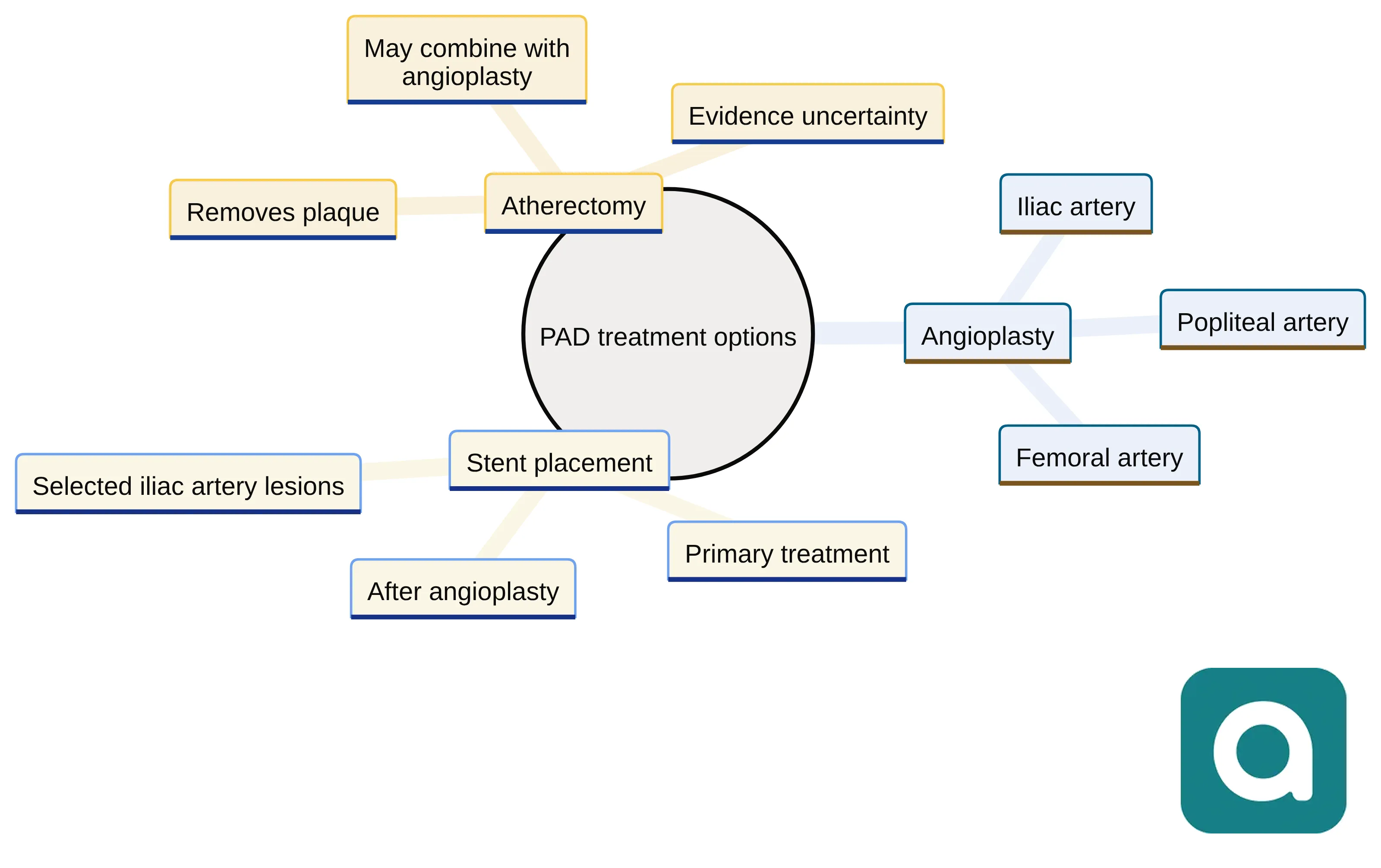
The cited guidance addresses angioplasty and stent placement for endovascular revascularization in arteries such as the iliac, femoral, and popliteal arteries. Angioplasty and stent placement can address narrowed arteries, but neither is suitable for every blockage: for selected iliac lesions, a clinician may use a stent first or after angioplasty, and in complex lesions primary stenting may lower the risks of embolization, arterial rupture, or dissection compared with balloon angioplasty alone. In complex iliac lesions, primary stenting may lower the risks of embolization, arterial rupture, or dissection compared with balloon angioplasty alone.
| Option | What the evidence addresses | Practical boundary |
|---|---|---|
| Angioplasty | Endovascular revascularization guidance includes transluminal angioplasty for arteries such as the iliac, femoral, and popliteal arteries. | The guidance does not make angioplasty a universal choice for every blockage or symptom pattern. |
| Stent placement | For selected iliac artery lesions, a clinician may use a stent as the primary treatment or after angioplasty. | “Selected” matters. The evidence does not make stenting suitable for every artery or every person. |
| Atherectomy | Atherectomy is a minimally invasive procedure that removes plaque from inside a narrowed artery. It may be combined with angioplasty in a broader revascularization plan. | Review evidence and registry findings leave meaningful uncertainty about when its added use is justified. |
Specific medication choices are outside this comparison. After your consultation, we provide a written plan that may include lifestyle recommendations, medications, testing, and referrals as needed. That statement describes how we organize care; it does not name a particular medicine or tell you to start, stop, or change one on your own.
At Amavita Heart and Vascular Health, we offer minimally invasive peripheral vascular interventions, but a service offering is not a personal treatment recommendation. Use the option’s purpose and the condition of your artery—not the word “new”—as the basis for your questions.
How do angioplasty and stenting fit into treatment decisions?
Angioplasty and stenting fit into treatment decisions when the clinician is considering endovascular revascularization for a specific artery and blockage. Guidance covers iliac, femoral, and popliteal arteries and includes angioplasty and stent placement. A separate article describes stent placement as a primary treatment or as a treatment after angioplasty for selected iliac artery lesions.
The artery involved, the location and severity of the blockage, your symptoms, and your condition all affect the discussion. A stent used for a selected iliac lesion should not be treated as a general answer for every PAD problem. Ask which artery is being considered and what the procedure is intended to accomplish.
A catheter-based procedure may involve catheterization, imaging guidance, and road mapping during the intervention. Those technical steps help the treatment team identify and work across the lesion, but they do not remove the need to discuss limitations, alternatives, and follow-up.
A useful angioplasty or stenting discussion should answer four questions:
- Which artery is narrowed, and how does that finding relate to my pain, walking limit, or wound?
- Is angioplasty being considered alone, or is stent placement also being considered?
- What condition or finding would make the plan change?
- Which test result supports this treatment discussion?
At our Kendall office, we provide vascular ultrasound and non-invasive testing when needed, along with interventional cardiology consultation. Bring your symptom pattern, wound history, and previous test reports so the conversation stays connected to your actual concern.
When might atherectomy be considered—and what remains uncertain?
A review summarized evidence showing that lower dissection rates alone did not justify choosing atherectomy over balloon angioplasty. The same review described a registry analysis that reported higher risks of any amputation, major amputation, and major adverse limb events with atherectomy than with stenting.
A registry analysis reports an association; it does not by itself prove that atherectomy caused those outcomes in every situation. The finding still matters because it argues against treating plaque removal as an automatic upgrade over another endovascular option. Ask what evidence supports atherectomy for your particular artery and what limitation the clinician is weighing.
We offer minimally invasive peripheral vascular interventions, including the type of service used to discuss PAD treatment options. A consultation should separate what a procedure is designed to do from what it can be expected to do for you.
What can studies of wounds and lower-leg arteries tell you?
Studies of PAD-related wounds show why the treated artery and the treatment approach need to be discussed together. One study examined interventions involving the popliteal, anterior tibial, posterior tibial, and peroneal arteries. It included thrombectomy and atherectomy and followed the study population for 12 months while they received optimal medical treatment.
The study compared people who did and did not undergo amputation during follow-up. It considered risk factors, the treatment approach, and the artery treated. Those details describe how the study was organized; they do not predict what will happen with your wound or tell you which procedure you should choose.
You can use the study’s structure to ask better questions: Which lower-leg artery is affected? What is the purpose of treating it? How will wound care and medical treatment fit with any procedure? Which follow-up signs should prompt a call?
Leg pain while walking and non-healing wounds are symptoms for which we recommend seeing a cardiologist.
That written plan gives you a place to record the treatment goal, the artery under discussion, and the next follow-up step. If you have a wound, ask who will manage wound care and what changes require prompt contact. Do not wait for a routine discussion if your leg suddenly becomes severely painful, cold, pale, numb, or tingling.
What should you ask before choosing a PAD treatment?
Before choosing a PAD treatment, ask for a clear link between your symptoms, the artery involved, and the proposed procedure. You do not need to memorize every technical term. You need answers that explain the purpose, limits, and next step.
Take these questions to a vascular or interventional cardiology consultation:
- What is the treatment goal: addressing walking pain, a wound, reduced blood flow, or a limb-threatening circulation problem?
- Which artery is involved—the iliac, femoral, popliteal, or a lower-leg artery?
- Is angioplasty, stent placement, atherectomy, or another approach being considered, and why?
- If atherectomy is being discussed, what evidence supports using it for this blockage, and what uncertainty should I understand?
- If stenting is being discussed, is the lesion one of the selected iliac lesions for which stenting may be used as a primary treatment or after angioplasty?
- What test or imaging finding supports the proposed plan?
- What may the written plan include regarding medication, testing, referrals, wound care, and follow-up?
- Which symptoms mean I should stop waiting for a routine appointment and seek emergency care?
At our Kendall office, we provide vascular ultrasound and follow-up care. When needed, we provide non-invasive testing such as an ankle-brachial index, Doppler ultrasound, or vein-reflux study. Ask which test applies to your concern and what its result will clarify.
When is leg pain an emergency?
Sudden severe leg pain with pale or cool skin, numbness, or a pins-and-needles feeling can be acute limb ischemia, a life-threatening medical emergency. Acute limb ischemia means that blood flow to the limb has suddenly decreased and needs urgent treatment to restore circulation.
If you have these symptoms, call 911 or your local emergency number. Amavita Heart and Vascular Health also advises immediate emergency-department care for sudden severe leg pain with a cold, pale limb. Do not use a routine consultation or callback request as a substitute for emergency care.
Leg pain that appears when you walk and a non-healing wound still warrant medical evaluation, but they are different from a sudden severe change with a cold or pale limb. Describe when the pain starts, how long it lasts, and whether the skin color, temperature, sensation, or wound has changed.
Our PAD guidance identifies leg pain when walking and non-healing wounds as reasons to see a cardiologist. Emergency symptoms need emergency action first.
What is a reasonable Miami-area next step?
We offer minimally invasive peripheral vascular interventions, with same-day outpatient care available when appropriate. We serve patients across Miami-Dade County from our Kendall and North Miami Beach locations, with care in English, Spanish, and Haitian Creole.
Bring a short record of your walking pain, wound changes, prior vascular tests, and questions about angioplasty, stenting, or atherectomy. A qualified clinician must decide whether an intervention is suitable for your condition. A website callback request does not reserve an appointment time. Sudden severe leg pain with a cold, pale limb belongs in emergency care, not routine scheduling.
What should patients ask about newer PAD treatments?
What are the treatment options for PAD?
Treatment options for PAD include minimally invasive procedures such as angioplasty, stent placement, and atherectomy. Each option has specific indications based on the artery involved and the severity of the condition.
When should I seek emergency care for leg pain?
You should seek emergency care if you experience sudden severe leg pain accompanied by pale or cool skin, numbness, or a pins-and-needles feeling, as these may indicate acute limb ischemia, a life-threatening condition.
What should I ask during a consultation about PAD treatment?
During a consultation, ask about the treatment goal, which artery is involved, the proposed procedure, and what evidence supports its use for your specific condition. It’s also important to understand the risks and follow-up care.
How does atherectomy work in treating PAD?
Atherectomy is a minimally invasive procedure that removes plaque from inside a narrowed artery. It may be considered when PAD affects walking or poses a risk to the limb, and it can be combined with angioplasty.
What is the role of stenting in PAD treatment?
Stenting can be used as a primary treatment or after angioplasty for selected iliac artery lesions. It helps keep the artery open and improve blood flow, but its suitability depends on the specific case.
Where can I get PAD treatment in Miami?
In Miami, Amavita Heart and Vascular Health offers peripheral artery interventions, including minimally invasive procedures, at locations in Kendall and North Miami Beach, with multilingual support available.
Have questions about your heart or circulation?
Reading only goes so far. Leave your number and a care coordinator will call you back within one business day, or call us now.