Prostate Artery Embolization
Prostate Artery Embolization: How It Compares With Medication and TURP

What is prostate artery embolization?
Prostate artery embolization (PAE) is a minimally invasive, transarterial procedure intended to reduce blood flow through prostate arteries to address symptoms related to an enlarged prostate. It is one possible treatment path alongside medication and TURP, not a universal replacement; your choice depends on evaluation findings, symptom goals, recovery preferences, sexual-function priorities, procedural risks, and uncertainty about future treatment.
TURP means transurethral resection of the prostate. Medication is another path to discuss. Each option answers a different set of concerns, so the right comparison is more useful than a simple claim that one treatment works for everyone.
The phrase “appropriately selected patients” appears in a multisociety position statement about PAE. That qualification matters. Your symptoms alone cannot determine whether PAE fits your situation, and a general article cannot replace an individual clinical evaluation. A useful discussion should cover what you want to improve, what risks you are willing to consider, which alternatives are available, and what follow-up may be needed.
A PAE consent discussion should address the procedure’s purpose, possible benefits, likelihood of success, risks, alternatives, complications, and what to expect afterward. Those topics give you a practical way to compare PAE with medication or TURP without treating a study result as a promise about your own outcome.
Why does PAE require an individual evaluation?
PAE requires an individual evaluation because professional guidance has described it as an option for appropriately selected patients, while reviews have identified continuing questions about patient selection, symptom response, and long-term durability. That does not mean you can determine suitability from the name of the procedure or from having an enlarged prostate alone.
Your clinical discussion should connect four parts of your situation:
- The symptoms you want to address and how they affect daily life.
- The treatment goals that matter most to you, such as symptom relief, recovery, or sexual function.
- The alternatives you want to compare, including medication and TURP.
- The risks, follow-up needs, and possibility of another treatment that you are prepared to discuss.
This framework does not produce a yes-or-no answer by itself. It helps you ask why a clinician recommends PAE, why another option may fit better, or what information still needs to be clarified before you decide.
Some situations need especially careful discussion. Researchers have said that more information is needed about PAE in people with local prostate cancer and in older adults, as well as about different embolic materials and their long-term effects. If either issue is part of your health history, ask how the available information applies to you rather than assuming that a general result answers the question.
What happens before, during, and after PAE?
PAE is a minimally invasive, transarterial interventional procedure, so your appointment should begin with a discussion of why it is being considered and how it compares with alternatives. The consent conversation should also cover possible benefits, risks, complications, expected recovery, and follow-up. Ask the clinical team to explain each stage in plain language for your situation.
Before the procedure, ask what the evaluation is intended to clarify and what information the team needs from you. Bring a complete list of medicines and a record of the symptoms you want to improve. Ask which alternatives remain available if PAE is not selected. These questions keep the decision focused on your goals instead of on the procedure name alone.
During the procedure, PAE is performed through the arterial system by an interventional team. The exact steps, medicines, monitoring, and technical approach should be explained to you by the clinician performing the procedure. Do not assume that a description written for another person or another center tells you exactly what will happen in your case.
Afterward, ask what symptoms or temporary effects may occur, what recovery activities are appropriate, and when follow-up will happen. A same-day setting describes how care is organized; it does not by itself predict how you will feel afterward or how much follow-up you may need.
That practice detail can help you frame practical questions about the visit, but it does not determine whether PAE is appropriate for you or replace the consent discussion.
What benefits might PAE offer?
PAE may offer improvement in urinary symptoms without requiring you to choose it as a universal substitute for medication or TURP. The Society of Interventional Radiology says PAE can improve urinary symptoms and may involve less recovery than traditional surgery, while emphasizing that individual results vary.
A randomized trial of men with BPH who had not previously received treatment reported that PAE outperformed combined medication for reducing urinary obstruction, decreasing prostate volume, and improving lower urinary tract symptoms. That finding applies to the treatment-naive trial group. It does not establish the same result for every person, especially if your history, symptoms, or prior treatment differs.
A review also reported that PAE may mildly improve erectile function and preserve ejaculation, while some surgical treatments may reduce those functions. Sexual function can therefore be a reasonable part of your treatment conversation, not an afterthought. Ask how the available findings relate to the specific alternatives under consideration.
Treat these findings as possible benefits to discuss, not as a prediction. Before choosing PAE, ask which outcome matters most to you, how it will be assessed, and what the plan would be if your symptoms do not improve enough or return later.
How does PAE compare with TURP?
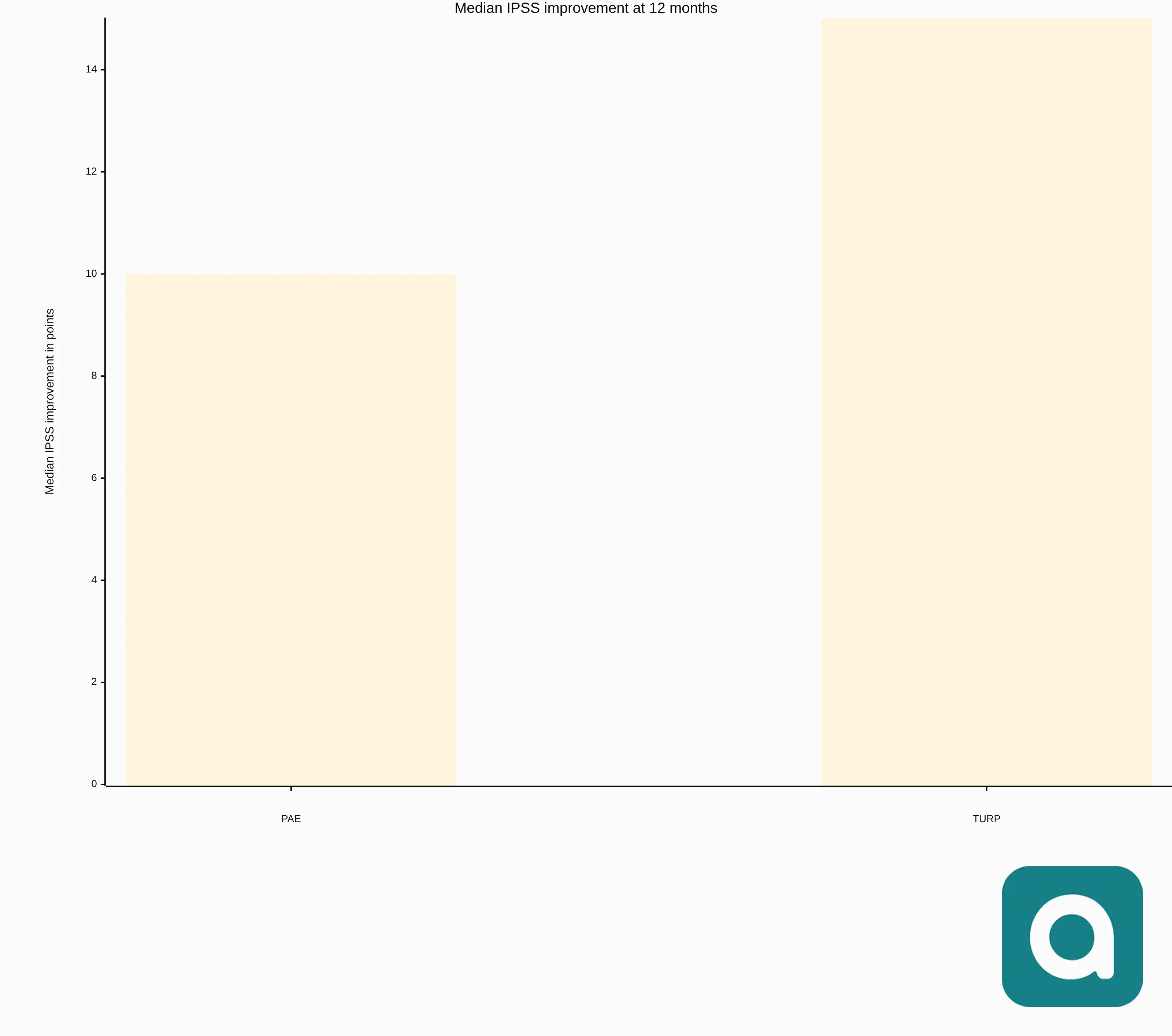
PAE and TURP were compared in the UK-ROPE observational study, which recruited 305 people across 17 centers in the United Kingdom; 216 underwent PAE and 89 underwent TURP. The study gives you a concrete comparison, but its results belong to that study population and do not decide your treatment.
| Shared question | PAE | TURP |
|---|---|---|
| What happened to symptom scores at 12 months in UK-ROPE? | Median IPSS improvement was 10 points. | Median IPSS improvement was 15 points. |
| What did that study establish? | It did not establish PAE as non-inferior to TURP for symptom-score or quality-of-life improvement. | It served as the comparison treatment in that analysis. |
| What did one two-year randomized study report? | The difference in IPSS reduction was less than three points, but the study was too small to prove non-inferiority. | It was the comparator in that study. |
| What should you ask about function? | A review reported that PAE may preserve ejaculation and may mildly improve erectile function. | The same review said some surgical treatments may reduce those functions. |
The results do not point to one universal winner. UK-ROPE found a larger median symptom-score improvement with TURP at 12 months, while another reviewed study found a smaller difference at two years but lacked enough participants to establish non-inferiority. Differences in study design, participants, follow-up, and treatment technique matter.
If symptom-score improvement is your main concern, ask how the clinician interprets these findings for you. If preserving ejaculation or limiting recovery is a higher priority, ask how those goals change the comparison. The useful next step is to name your priorities and ask how each option addresses them.
How does PAE compare with medication?
PAE and medication were compared in a randomized trial of men with BPH who had not previously received treatment. The trial reported greater improvement with PAE than combined medication for urinary obstruction, prostate-volume reduction, and lower urinary tract symptoms. That result describes the trial group, not every person considering treatment.
| Shared question | PAE | Combined medication |
|---|---|---|
| Who was studied in the randomized comparison? | Men with BPH who had not previously received treatment. | The same treatment-naive trial group served as the comparison. |
| What outcomes were reported? | Greater improvement in urinary obstruction, prostate volume, and lower urinary tract symptoms. | The trial reported less improvement than PAE for those outcomes. |
| What should you clarify before applying the result? | Ask whether the trial population and procedure fit your situation. | Ask how your existing treatment history and goals affect the comparison. |
| What remains uncertain? | Reviews have identified questions about patient selection and duration of symptom response. | The trial result does not by itself decide whether changing or continuing medication is right for you. |
If you already use medication, the study does not tell you whether continuing it or moving to PAE fits you; ask whether its treatment-naive population applies, and weigh your symptom goals, concerns about procedural risks, and willingness to accept uncertainty about retreatment.. A clinician can then place the trial finding beside your treatment history rather than treating it as a personal forecast. Use your treatment history as a starting point. If you have not tried medication, ask what role medication would have before a procedure. If you already take medication, ask what the clinician would be trying to learn by continuing or changing it and how that plan would be compared with PAE. The available trial does not answer those questions for people with a different history.
Your priorities can also change the comparison. Someone who places a high value on avoiding an arterial procedure may want a clear medication discussion rather than proceeding directly to PAE. Someone whose symptoms remain troublesome despite medication may want to focus the visit on whether PAE offers a reasonable alternative, while still reviewing its risks and the possibility of another intervention. If sexual function, recovery, or the chance of needing future treatment matters most, say so directly; those goals can shape which trade-offs the clinician explains. Ask how improvement will be measured, how long the plan will be assessed, and what would prompt a change in treatment. This makes medication a real comparison point rather than an option mentioned without context.
What are the risks, limitations, and recovery questions?
PAE has risks and limitations that should be discussed before you choose it. In UK-ROPE, reoperation was reported in 5% of patients before 12 months and 15% after 12 months, for a reported total of 20%. The report also included infection, bleeding requiring transfusion, arterial injury, groin hematoma, and non-target embolization associated with self-limiting penile ulcers.
Those were study-specific findings, not your personal odds. Rates can vary with the population studied, the technique used, and the length of follow-up. Ask which complications the team considers relevant to you and what would happen if one occurred.
A review reported that PAE participants experienced almost half as many adverse events as TURP participants in a cited two-year study, but the reviewed passage did not provide the underlying event counts. That comparison should be read with care. It does not remove the need to discuss PAE-specific complications or tell you how your recovery will feel.
Recovery questions belong in the consent conversation. The Society of Interventional Radiology says PAE may involve less recovery than traditional surgery, while the consent resource calls for discussion of what to expect afterward, risks, alternatives, and complications. Ask for practical instructions about activity, symptoms that should prompt a call, follow-up timing, and what happens if improvement is slower than expected.
Keep those separate when you compare options.
How certain is the long-term evidence?
Long-term certainty about PAE is limited by the amount and length of follow-up in the available studies. An earlier review found relatively few randomized trials, reported that many focused on short-term outcomes, and noted that only two randomized trials had published data beyond 12 months at the time of that review.
The same review summarized one retrospective study of more than 1,000 people. That study reported reintervention rates of 3.4% at one year, 21.1% at five years, and 58.1% at 10 years after PAE. A reintervention rate describes another intervention reported during follow-up; it is not a promise that you will need another procedure, and it is not the same as saying that every person’s symptoms returned.
These findings make durability a necessary question rather than a reason to assume failure. Ask how long the available follow-up lasts for the outcome you care about, what may happen if symptoms return, and how another treatment would fit into the plan. Researchers have also said more information is needed about local prostate cancer, older adults, different embolic materials, safety profiles, and long-term clinical impact. The clinician discussing your case should explain how those limits affect your decision.
Why do recommendations about PAE differ?
Recommendations about PAE differ because professional organizations have not always taken the same position at the same time. One review reported differences among guidance from NICE, the European Association of Urology, and the American Urological Association; it stated that the AUA guidance at that time recommended PAE only in a clinical-trial setting.
That wording describes the guidance as reported in the review, not a timeless rule. Recommendations can change, and the review does not determine which guidance applies to you in Miami. Ask which current clinical guidance the clinician uses and how it relates to your symptoms and treatment goals.
A different position came from a multisociety statement dated May 1, 2019. It said PAE should be presented as a treatment option for appropriately selected patients with an enlarged prostate. The difference between that position and the guidance described in the review is why a careful consultation should explain both selection and the basis for the recommendation.
You do not need to settle the policy question before asking about your own choices. Ask what supports the proposed option, what alternatives remain open, and what uncertainty you should weigh.
What should you ask before choosing PAE?
Questions for a PAE discussion should cover selection, alternatives, expected changes, risks, recovery, sexual function, and follow-up. You can take this list to an appointment:
- What findings make PAE reasonable for me, and what findings would make another option more suitable?
- What is the main treatment goal in my situation: urinary symptoms, obstruction, prostate volume, quality of life, or something else?
- How does my situation compare with the people studied in the PAE trials?
- What should I understand about the risks of arterial injury, bleeding, infection, groin problems, or non-target embolization?
- What will the consent discussion cover about benefits, alternatives, complications, and what to expect afterward?
- What will happen before, during, and after the procedure in this care setting?
- What follow-up will I need, and how will improvement or persistent symptoms be assessed?
- How does PAE compare with medication and TURP for the goals that matter most to me?
- How should preserving ejaculation or considering erectile function affect the comparison?
- What is known about the possibility of another intervention if symptoms return?
- Which guidance or position statement informs this recommendation, and how does it apply to my case?
- What costs, coverage questions, and scheduling details should I understand before proceeding?
The purpose of these questions is to make the decision specific to you. They do not determine candidacy on their own.
What is a reasonable next step in Miami?
Discuss PAE, medication, and TURP with a qualified clinician, considering your symptoms, goals, recovery preferences, sexual-function priorities, and tolerance for uncertainty about future treatment.
Bring the questions above and ask for a plain explanation of why one option fits your situation better than another. Only a qualified clinician can determine individual suitability, discuss the risks that apply to you, and explain what follow-up would involve.
What should patients know before requesting a PAE discussion?
What is prostate artery embolization?
Prostate artery embolization (PAE) is a minimally invasive procedure used to treat symptoms related to an enlarged prostate.
What happens before, during, and after PAE?
Before PAE, you’ll discuss the procedure, its benefits, and risks with your healthcare team. During the procedure, an interventional radiologist performs the embolization through the arteries. Afterward, you’ll receive instructions on recovery and follow-up care.
How does PAE compare with TURP?
In studies, TURP has shown greater symptom improvement than PAE at 12 months. However, PAE may have advantages in terms of recovery and preserving sexual function, making it important to discuss your specific goals with your clinician.
What are the risks and limitations of PAE?
PAE has risks such as infection, bleeding, and the need for reoperation. It’s important to discuss these risks with your healthcare provider to understand how they may apply to your individual situation.
What should you ask before choosing PAE?
Before choosing PAE, consider asking about the reasons for recommending this procedure, the expected outcomes, potential risks, recovery process, and how it compares with other treatment options like medication or TURP.
Have questions about your heart or circulation?
Reading only goes so far. Leave your number and a care coordinator will call you back within one business day, or call us now.